Pages

Tuesday, 30 April 2024

The Importance of simple Problem Solving

One struggle for many students in solving problems is that the problems are just too cognitively demanding. 

If a student has just begin to grasp a new process or idea, is it fair to then ask them to dive into a open ended task that requires skills beyond mathematical understanding, such as perseverance and communication?

This is why one of my most importnant strategies for problem solving is to aim for the maths involved to be at least one academic year below the current topic. Multiplying 3 digit by 2 digit? Explore 3 digit by one digit problems. Learning about prime numbers? Do an investigation into odd numbers first.

By simplifying the problem, students can achieve more success and build confidence to attempt further problems, or simply learn to enjoy the subject and its beauty.

Take for example the simple prompt:

The answer is 10. What is the question?

This is accessible for Year 2, but equally just as good for Year 5 and 6. We can build on this through rich conversations. Let the students set the parameters. Are negative numbers allowed? Can we use fractions? Decimals? It has to be whole numbers? Is addition the only operation we can use?

We can keep extending it. What if the question was a diagram, a picture? Are there infinite possibilities? How do you know? 


How about restricting answers to a question so there are manageable finite solutions:


Here one student said to me "There are so many answers, it will take forever!" 

I replied by asking, if we forget about prime numbers for a second, what numbers would work?

I also gave the prompt, what is 10 x 30? 300? Ah that would be too big. This question and response was enough for some of my students to go off and complete the problem. I wasn't totally happy that I gave them that much help, but at an early stage of learning to problem solve there is still a lot more for them to explain here and so guiding them will still lead to great discoveries.

Basically, problem solving should be treated like fluency - grab some early wins for the students, have them access and feel comfortable with the topic and then stretch when they are ready and engaged.

Key tips:

    • Set up problems that involve maths from the previous academic year or two
    • Model how to share explanations to a problem, including giving sentence starters
    • Scaffold as much as necessary to allow students to work on the problem. Don't leave them struggling. Reduce the possible answers if possible
    • Share answers - show them it wasn't impossible (some students won't want you to reveal answers, but realistically they very rarely carry on trying to solve it, better to just show the answer.
    • By encouraging these tips, after two or three school years, students will face problem solving with a positive approach, a bank of successes to think back on, and a wealth of experience in similar tasks.


Sunday, 14 April 2024

Multiplication Game


I love simple mathematics games that can be reused over and over. Also ones that combine strategy and fluency, such as this multiplication game. 

Fairly self explanatory - two players, each take turns to choose a number from the top and the bottom and multiply them together. The answer will be in the grid, and the aim is to get four in a row on the grid.


Link to PDF Here

One observation is watching students reverse their thinking, "Oh I need 3204, that is an even number and it ends in 4, which numbers will help me achieve that result"

Completeness - Fraction Multiplication


I recently came across a fun question (I think from White Rose Maths) but I thought it had missed a trick, so I amended it to allow for more explanation:


This first question proved much more difficult than the second one, given you have less numbers to use. I think I would have preferred the other way around first.


It was fascinating to see the different approaches to solving it. Most dived in with brute force, trying as many numbers as they could. One student was adamant it was impossible, so I asked her to prove it was impossible.
"How do I prove that it is impossible"
"Well, start with why you think it is impossible?"
"Because it is hard"
"What exactly is hard?"
"There are no fractions that work, I've tried them all"
"Show me you have tried them all then"

At this point she realised she hadn't considered improper fractions and so was focused in on a more rigid approach.

One student made an excellent discovery (we have only taught up to multiplication of fractions). 
"We can just flip the numbers and it still works"
"Which numbers did you flip? Do you have to flip all of them?"
"Just the fractions, but they both have to be flipped"
"Does that help when finding non-solutions"
"Maybe. Maybe all the answers are in pairs"


Turning a question into one of completeness and asking them to PROVE and EXPLAIN really gets the students thinking about how to strategise and solve complex problems. It also sowed the seeds of reciprocals and division, but I did not need to explain this here, it was of no significance to their process at this time and would cognitively overstretch them and take them away from their own strategies.


Monday, 10 October 2022

 This year I've been working with a small group of students who are aiming for any level of pass in their upcoming IGCSE.

In order to simplify the study, we've concentrated our efforts on about 45% of the paper. Pretty much all of the algebra (apart from completing the square and graphing and lines of equations) and FDP, as well as data.

Some of the students have difficulty with processing complex information or struggle with cognitive load, so most of the topics we cover are the straightforward questions that can be solved with a a simple algorithmic approach.


Anyway each week se spend 45 minutes on only algebra, and 45 minutes on everything else, leaving the extra double lesson to look at past papers or teach/refresh a new topic.

The constant spaced repetition seems to be working - so sharing the sheets I created, questions, taken from a variety of places, including the amazing Dr Austin and Boss Maths to name a couple. When I get to the end, I simply start again from the start! I'm adding more to the Everything Else sheets as we teach it.


Algebra Qs


Answers


Everything Else Qs


Answers

Tuesday, 13 February 2018

Division Games


Here are some activities for division, particularly useful in a primary setting.

The 'Race To One' sheet is particularly liked by my recent year 3 class.


Slideshow of them (So I can dynamically add to the slides over time) or you can download as PDF version below.


Download Slides as PDF


Monday, 12 February 2018

Circles and Pythagoras


I've not used Geogebra for a while - I forgot how fun it is!


This is similar to a problem from many sources, such as this excellent University of Georgia article


Saturday, 10 February 2018

Find Me... Grids


A simple but rich activity.

Find Me Grids

There is a template version available to create your own - although it isn't hard to create the model yourself.


Depending on age and ability, they could create their own - or explain understanding.

The document is visible on google slides, you can print any page you need - there are a couple that are slightly different just because it is hard to create fractions in google slides.


I will keep adding to the slide link below so keep this page bookmarked.

Template Link

Tuesday, 24 October 2017

A New Chapter

A lot has changed since I last posted on the blog. And I do mean a lot. After spending a year working in Primaries and tutoring students from age 6 to 26 in Maths and English, and most importantly caring for my children, it was time for a fresh start.

So... we moved... to Hong Kong. This is not a blog about moving to Hong Kong. That is here. I am now part of an international school, working at primary level. So as a result, my blog is being resurrected, as this past year I have spent collating and sharing some of the great resources we have in secondary with primary teachers. Now, my big job is to support this idea of mastery - identify resources that allow teachers to dig deeper into certain topics, and offer tips and hints on some of the basics too.

Many of the resources I refer to will be referenced and praised as they should - but there will be a real mix of age related resources so I will at some point try to organise it in the way Don Steward or Resourcaholic does.

Monday, 3 October 2016

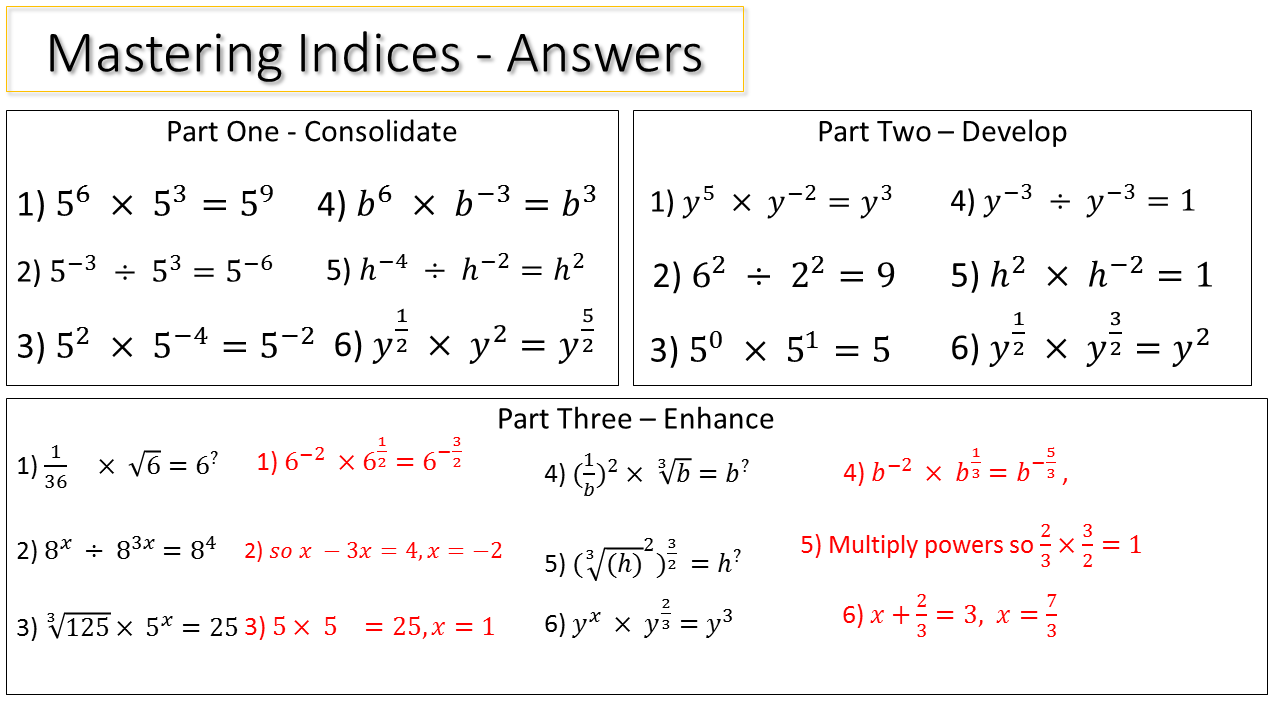
Indices/Powers Extension


Once you have mastered Indices at GCSE, there isn't a lot of investigation without going into logs, so I created these sheets - they are difficult and would probably do well in A level classes too.


Tuesday, 2 August 2016

Drawing Challenges - Geometry Proof

I've used these for introduction to proof, angles and any geometry subject really.

Encourage the student to give an absolute reason why they might not be able to complete any of the challenges.

I usually ask students to prove or draw on the whiteboard as we are going along. Students can use peer work as they work themselves. Sometimes I might send someone who is wrong up to the front to draw their solution - this normally generates great debate and questions many students working.


Wednesday, 20 July 2016

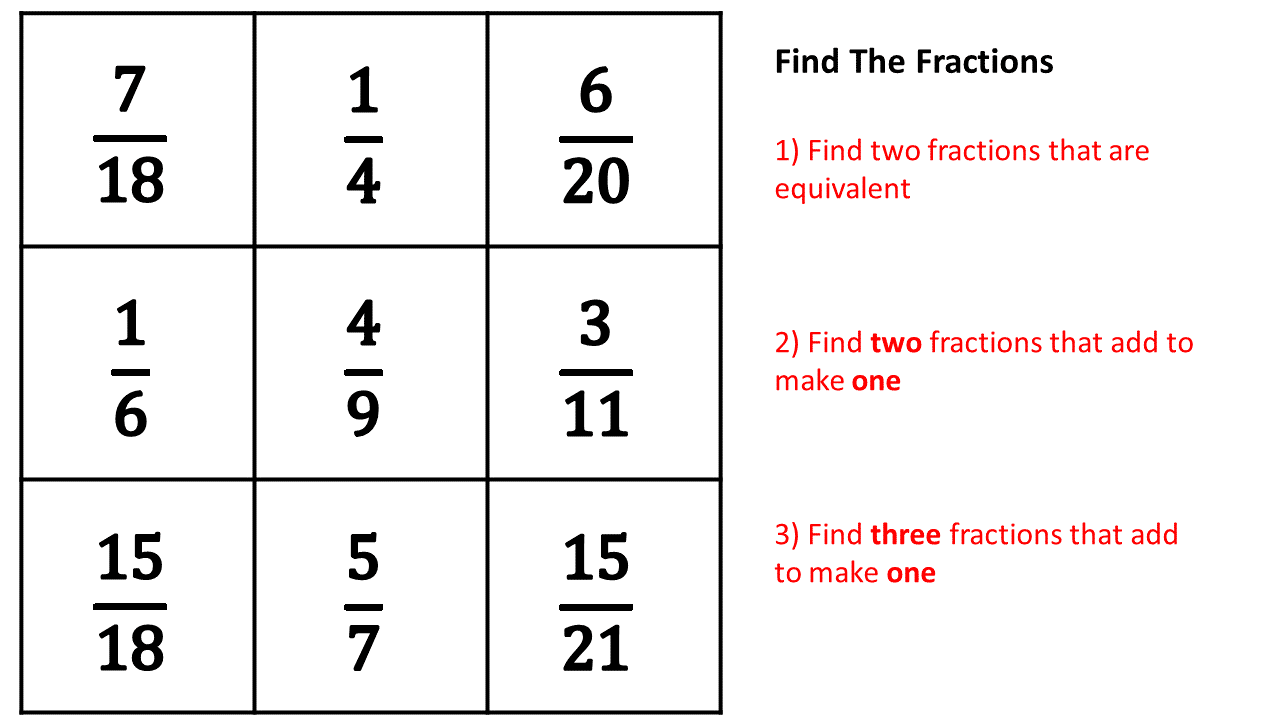
Fraction Finding - Mastery Exercise

Fraction Finding - Mastery

Low entry - use when students can add fractions together. The higher ability students should be looking for strategies to quicken the guessing process.

Finally - create your own homework for another student.


Sunday, 3 January 2016

Ratio Boxes


I saw a question recently in the new AQA textbooks that got me very excited. The reason is that it is low entry. All these style questions can be solved with simple trial and error and some basic simplifying of ratio.


However, life is made a lot easier if you use normal techniques for dividing into a ratio. It is a real puzzle question which tests deep understanding of the work, whilst also offering an opportunity to at least have a go in some way. If this is the way GCSE's are going, then I can't wait!

Below are some extra extension questions I have made to have a go at too. They come with solutions :)


Monday, 28 December 2015

Resource Sharing - sometimes a bad thing?

It's been a while since I posted, as life has been fairly hectic in recent months.

A new job has kept me busy, and I have enjoyed the challenge of a new school and department fighting their way out of special measures. However, with much of my time spent on behaviour management and familiarising new routines, I have barely had time to consider fresh ideas on teaching strategies and writing new resources.

Thank goodness for Resourceaholic, Don Steward and #mathschat. Barely a week has gone by in the last four months without spending some time on these sites. I raid my extensive pen drive for resources, and then cross check the two blogs above to confirm whether or not there are better resources available.

All of this leads me to ask a serious question about my current attitude to resource sharing. Have I become too lazy to value my own ideas for teaching? I am excited to use well thought out and substantiated resources, without question. I do wonder though, would I be more enthusiastic if I used my own ideas?

One lesson in particular was a parallel lines and angles lesson with a low ability year 9 class. I had a plan ready, but only 9 students turned up to the lesson. So I did something I have rarely done. I ditched the plan and went with an idea in my head.
We put some tables together, sat round it and stuck some coloured tape across the table. We marked some angles, did some measuring, and proved some angle rules. The students were really engaged, they got to write on the table, and they left the lesson with a real positive attitude. It was clear they enjoyed it as much as I did.
This isn't a preach of how good this resource is - and it certainly isn't some revolutionary new resource, but it was my own idea at that time.


Was it the idea, or the fact I was enthusiastic and showing a willingness to do something different?
I have always been commended on my use of interesting ideas (cue trumpet blowing noise) and yet, given the other pressures of teaching and the fantastic blogs and resources out there already, I have turned my back on my own thoughts, and settled for other teacher's fantastic resources.

Perhaps we should always take time to produce a really well thought out resource if, for nothing else, it inspires us to believe in our own work.

Tuesday, 10 March 2015

Resources - BIDMAS, BODMAS, PEDMAS


I like topics that drip through and affect other areas of the curriculum. If you don't get order of operations, it could haunt you for the next 5 + years.
As oppose to say, circle theorems.


I'll start by directing to Resourceaholic - there is almost everything you need on there. In fact, once you click on this link, I may never see you again.

Resourcaholic Number

I start by playing Family Fortunes with the BIDMAS or BODMAS (whatever the school preference is) and ask the pupils to guess the order, with sound effects. It's not easy to upload this and explain how to set this up, but if you message me I will tutor the process.


I then explain BIDMAS and PEDMAS (American version) too.

We have a discussion about whether it matters about addition and subtraction. I always write

3 - 2 + 1

And explain I can actually get two answers (zero and two).

2 + 1 = 3
3 -  3 = 0

This causes great debate until we conclude that the negative in front of the two is IMPERATIVE.

Then activities, some from the link above, some from: Number Loving and some from Maths Box - which I have linked to here:

I use the order of operations settler as a competition - each person highlights five questions. Then they work out the answers. Then they add them up, and I give a prize to either the highest, lowest or nearest to 20 etc etc.

Round Robin Bidmas is a good activity. The idea here is each person answers a question, but the others do not say anything - they also do not correct anything. Then, when it is done, they check all the answers together, looking for any mistakes. That is when the discussion is great and rewarding.

Also some treasure hunts in the link too.

My activity Crack The Padlock can be used with this Bidmas resource

Finally a puzzle to finish:


All resources are here, or in links above


Tuesday, 17 February 2015

Data - Averages Resources

Here are some resources I use when teaching Averages.

I find the word 'average' fascinating. Used in everyday language, and as a mathematician, I immediately think, "well... which average?"

I always wonder this when entering an "average speed check" section on the motorway. Which seems to be everywhere in the north west now.

Here is an activity linked to Speed Cameras, and some real life application.

The powerpoint with questions on slides is available here: Law Abiding Drivers
It links well with SDT topics too.


Here are a mixture of questions and projects including some that take longer than others.

Mixing Numeracy and Literacy


Football related averages - could be easily changed to Rugby

Quick question which is certainly seen in real life

Another interesting Football study - prizes for top predictions

This last one I have used for nearly every class I have ever taught. Every time I have done it, boys have outperformed barring the odd outlier. I have also done this with a target Velcro game in class. If a big class, then can be used for mean from a table as well.

Another project I did last year and will do probably every major football tournament is based on Yummy Math's World Cup Draw

I have written up my own task which is available here. Bit dated now but the idea can be used for the future : Fair Draw

Oh and the obligatory averages puzzles: (I think from Don Steward)


Answers via the link - Problem averages


Other useful links for averages worksheets


Sunday, 7 December 2014

Crack the Lock Activity


Here is an activity I use to encourage the students to work through some question in class.


It does require some initial monetary outlay, but it can be used for a very long time.

You will need some sort of locking mechanism, a padlock or safe, that requires a three (or four) digit pass code to unlock.

It should be visible to the class, It works better than a virtual one, although if you could find a digital one professionally done then that might be quite interesting.

Have a prize inside, and sometimes wrap it in an extension activity, in case they crack your code early.

I have a lock which can be reset to different combinations, you can get them for under £4 from Ebay or Amazon. I have also been trying to find a safe deposit box that works with a padlock, but yet to find one, so I bought some chain links from Homebase, for about £2. I then wrapped it round a normal tin and this is what I get:


The worksheets are then designed to give three numbers which relate to the code. I do not check their work until after they have tried the code. If a student tries to guess the code, we can have a discussion on permutations and chance, and the only rule is that you have to wait three minutes before your next guess.

The worksheets cover many misconceptions as they include true or false statements. So some are straightforward, whilst others can encourage debate.

Of course, locking the safe back up so other finishers can guess the code is fairly straightforward.


Those that finish first are asked to note down in their books three key facts that helped them solve the code, and then they can support other teams. So far I have seen relatively little cheating.

Here are the link to some sets of questions, starting with percentages and fractions, I will add more as I do them in lesson. Please feel free to create and share your own.

The worksheets


I actually think you could use a plastic bag as a safe: Put a box in the bag that is big enough so that if the bag handles were locked together, you couldn't get the box out. Sure, you could rip the plastic bag, but if you have nice students I don't think that would matter!

Saturday, 6 December 2014

Santa's Route - Lines of Equation

I haven't posted for a while - I will be uploading a resource soon that I use as a way to keep interest in practising and perfecting work.

For now, here is a simple Christmas resource.

Maths is always fun, so doing fun lessons in the last week of term doesn't really change for me. (although I do let my prize winning class from the mistakes chart watch Flatland)

I do like some Christmas themes to my work though. Just like this post from solve my maths.

Here is a simple task on working with and finding equations of lines.

There are two tasks, and the first one is differentiated to allow easy entry.


Basically, Santa needs to plot his 2D Cartesian route between houses (obviously) and does it by plotting equations.


In the harder task: you are required to find the houses, having been given some information about the lines that need to be plotted.
All the documents are available here - including answers for the harder task.

Tuesday, 14 October 2014

Percentages with Dragons!

I don't have many differing resources for Percentages. It's probably up there with basic operations as the most important part of Mathematics to our learners, but since this is the case, there are bags of resources online to support with this.

I have two resources to add that are a little bit different:

Some higher level thinking and problem solving with percentages:


Next is my Dragon's Den percentages: It is for reviewing / revising percentages and there is a difficult one (with various compound interest calculations) and a more simpler one for practising basic increase and decrease.

Basically - the students invest a portion of their 10k into a choice of three companies. They can choose to invest in two if they like, but not all three.
After everyone has written in their investment choice on the attached sheet, they then work out the money they have made or lost. There is an example on the sheet, but I think it relates only to the higher powerpoint. Also, be warned that I teach to a point where we use multipliers, so if you don't do that you might have to tweak your answer sheet.
The biggest obstacle I have run into when running this activity is that students don't carry over the money correctly into the next round. 

All the companies exist (or have been pitched in the den) - and if I have given them a green, then they have had investment and may have been successful.

I trust my students to check each others work each round, and we take time to go through the workings at the end of each round. They will also never run out of money - as they just lose a percentage of their investment.

The best round is number two - none of the investment opportunities are worthwhile. The students did not need to invest in any if they don't want!


All the bits are available here:

Percentages - Dragon's Den and Other Problems


Finally - I'm sure you all know this clip: but it is a great plenary. The teacher doesn't know - but does anyone in your class?


The video is available via the link above as well.


Sunday, 5 October 2014

Prime Numbers, Factors and Prime Factors

Here are some resources and ideas I use when teaching topics involving Primes and Prime Factors.

There are a few ways of spotting prime numbers - including Sieve of Eratosthenes, which I still think is a bit forced.

I like the links to Area (which they may not make straight away, depending on ability). I recommend doing this using multilink cubes: Idea taken from Don Steward


I give 25 cubes and ask the students to record how many ways they could rearrange cubes to represent the numbers from 1 - 25:


Then this leads to discussions about Factors, Square Numbers and what it takes to be a prime number.

If you want to go onto Prime factorisation, then try it a different way - show how powerful prime numbers can be. Set a target - make it a game - after a while allow them to choose one more number to add to the list. Ask them why they wanted that number..


Then comes lots of different activities:


Collective Memory - have the students copy the image down from memory and then fill in the numbers when done.


I can't believe I have never heard of Shikaku until this week. It is also referred to as rectangles. It's so perfect to consolidate factors (i.e. knowing that 10 could be one strip of ten or two strips of five) and also help with Area too.
This website allows you to choose loads of different levels of difficulty, meaning differentiation is easy! Also can be done on the website (with timings for extra competition) or printed. There are also a bunch of apps too with the game.


My last resource this post is Factors bingo - if you haven't played this before I will be surprised, but nevertheless here are the rules:


Other places to look for resources on this include, as usual, Don Steward's median blog.

Also check out some good Factor resources on resourceaholic

My last comment is really about selling this topic, particularly primes. There are lots of interesting research and books about prime numbers, and whilst much of it would go over many student's heads, I still think there is value in you discussing that these things are out there. Sound enthused about things you have read, the fact that there are monetary prizes for finding primes, or that internet encryption is based on the idea that no-one has found a quick way to check if a number is a prime number.

Thanks - any other good links then let me know!


Wednesday, 24 September 2014

Number - Place Value Resources


One of the easier topics in the curriculum - Place Value - can still perplex many students, particularly when talking about the values of the digits after the decimal point.

I still have students who struggle with ordering decimals and calculating which is closest to a certain value. I also come across students who struggle with the terminology.

Place value is one of those topics than can be addressed through mini activities throughout the year, and it always helps to reinforce the topic - even with high ability students.

I like this as a starter:
The discussion is important afterwards - question their strategies. There is also a harder set as well, which involve decimals. Hopefully some discussion about place value will occur.

Link - Place Value Starter

Another useful way to introduce some 'fun' (of course it is all fun) is with the 'Place Value Game' . There are many variations of this, I don't claim this as my own by any stretch. Mine has a full class version (which I usually play last lesson of term) and a two player version.


Link - Place Value Game


I move onto a Prezi which zooms into a unit to show that it can then broken down into smaller denominations.

We talk about notation then - which one is called what, and why. I think it is super important to explain what 1/10 is. It is a wow moment to many that 0.1 actually shows one tenth. 0.6 is six tenths so 6/10.

One way to consolidate is to play Place Value Bingo. This is a sneaky resource I made. Its a fairly straightforward Bingo - but great for assessing progress. If you play to Full House - which isn't long at all - then you'll end up with 1 in 7 of your class winning at the same time. If you then play one more slide - everyone will win.
So... if there are any students who don't have Bingo - make a note, tell them unlucky, and you know they need some support.

Link - Place Value Bingo

Don Stewards Blog as always, has some good resources with place value and decimals, but the best are found under Decimals labels rather than place value.

I particularly like Decimal Nim:

Finally, two worksheets I use, mainly for lower ability - or an easy early in the year homework.

Rearranging decimals given the text, or spotting the missing place value - is actually done quite poorly in a lot of cases. Something different to many other questions.


Comparing decimals worksheet - not particularly all singing or dancing - but it does a job. I like the extension at the bottom of this sheet - and the rearranging letters section spells out MR HILL SMELLS, so you might want to change that. I tell my class that I got the sheet from a fellow teacher, and that I don't know the answer. Bit of acting when I hear the answer and it generates some cheap laughs :)

Any other ideas out there?